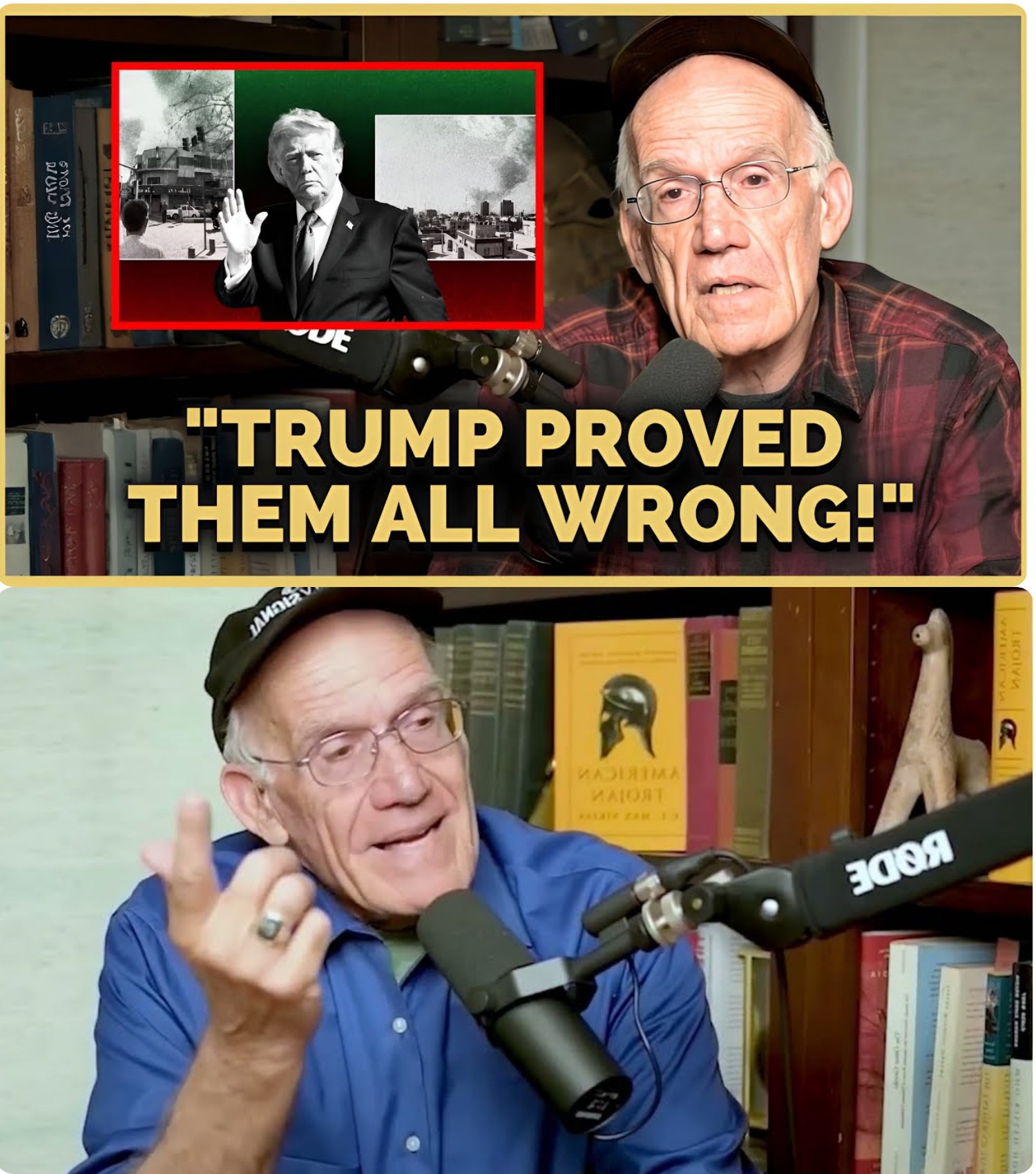
Victor Davis Hanson: “Iran Thought They Can Outlast Trump… Boy Were They Mistaken!”
Reframed Title:
“Victor Davis Hanson on Iran, Trump, and U.S. Power Politics: Strategy, Oil, and the Future of the Middle East Conflict”
Blog: Iran, U.S. Strategy, and the Debate Over Power, Deterrence, and Global Stability
Introduction
The geopolitical tensions between the United States and Iran remain one of the most complex and enduring conflicts in modern international relations. In a recent commentary, historian and political commentator Victor Davis Hanson offered a forceful interpretation of how U.S. leadership—particularly under former President Donald J. Trump—has reshaped the strategic balance in the Middle East.
The discussion touches on military deterrence, economic pressure, nuclear concerns, regional alliances, and the broader ideological divide shaping American foreign policy. While the rhetoric is strongly opinionated, the underlying themes reflect long-standing debates in U.S. strategy: how to deal with adversaries like Iran, how to protect global energy routes, and how domestic politics influences foreign policy decisions.
This blog breaks down the major arguments presented, while also placing them in a broader analytical context.
1. The Central Claim: Deterrence and Power Projection
At the heart of the discussion is a core strategic argument: that Iran has historically relied on delay tactics in negotiations while expanding its strategic capabilities in the background.
According to this perspective:
- Iran uses diplomacy as a tool of strategic delay
- Negotiations are often seen as stalling mechanisms rather than final agreements
- Military and economic pressure are necessary to alter Iranian behavior
This reflects a classic theory in international relations known as deterrence theory, which suggests that states are more likely to comply when faced with credible consequences.
Supporters of this view argue that Iran responds primarily to strength rather than diplomacy alone, while critics argue that sustained diplomacy is essential to preventing escalation.
2. The Trump Doctrine in the Discussion
A major theme in the commentary is the role of Donald J. Trump in reshaping U.S. strategy toward Iran.
The argument presented suggests that:
- The Trump administration applied stronger economic and military pressure
- U.S. actions damaged Iran’s military and nuclear infrastructure
- Negotiation timelines were shortened and more aggressive
Supporters of this interpretation claim that such pressure creates leverage, forcing adversaries to reconsider their position.
Critics, however, argue that:
- Excessive pressure can increase regional instability
- Military escalation risks unintended consequences
- Diplomatic channels are essential even under tension
Regardless of viewpoint, the discussion highlights a broader reality: U.S. foreign policy toward Iran has oscillated between engagement and pressure for decades.
3. Nuclear Concerns and Strategic Uncertainty
One of the most critical issues raised is Iran’s nuclear capability. The commentary emphasizes uncertainty about:
- The number of missiles and drones available
- The location of underground facilities
- The speed of potential reconstruction after strikes
This uncertainty creates what strategists call a “fog of deterrence”—where incomplete information makes decision-making more difficult.
The argument suggests that:
- Even partial destruction of infrastructure may not eliminate long-term capability
- Iran may be able to rebuild over time
- Continuous surveillance and readiness are required
This reflects a key challenge in modern warfare: destroying physical assets does not always eliminate knowledge or capability.
4. The Strait of Hormuz and Economic Pressure
A significant portion of the discussion focuses on the strategic importance of the Strait of Hormuz, one of the world’s most critical oil transit routes.
The argument presented is that control or disruption of this region could:
- Severely impact global oil prices
- Pressure Iran economically
- Affect global markets and political stability
Iran has historically used the threat of disruption in the Gulf as leverage in negotiations. Meanwhile, Western powers view freedom of navigation as essential to global economic stability.
This creates a high-stakes balance:
- Too much pressure risks escalation
- Too little pressure risks emboldening adversaries
5. Iran, Regional Proxies, and Security Networks
The commentary also highlights Iran’s role in supporting regional groups such as:
- Hezbollah in Lebanon
- Hamas in Gaza
- Other allied militias across the Middle East
From this perspective, Iran is described as exporting instability through proxy networks.
However, analysts of Middle Eastern politics emphasize that:
- These relationships are complex and often politically motivated
- Regional conflicts involve multiple actors, not just state sponsorship
- Local grievances also play a major role
Understanding these dynamics requires distinguishing between state policy, ideology, and local political realities.
6. Domestic U.S. Politics and Foreign Policy Debate
Another key theme is how American domestic politics influences foreign policy toward Iran.
The commentary suggests that:
- Political polarization affects military decision-making
- Anti-war sentiment competes with security concerns
- Economic conditions, such as oil prices and employment data, shape political urgency
This reflects a well-known pattern in U.S. politics: foreign policy is rarely isolated from domestic electoral considerations.
For example:
- Rising fuel prices can reduce public support for intervention
- Elections can shorten strategic timelines
- Congressional dynamics influence executive decision-making
7. The Role of Ideology in Interpretation
The discussion also introduces ideological framing, particularly in describing political opposition to military pressure on Iran.
The argument suggests that:
- Some political groups prioritize de-escalation over confrontation
- Others emphasize national security and deterrence
- These differences shape how Iran policy is interpreted
In reality, both perspectives exist across the political spectrum, and foreign policy debates often reflect deeper philosophical disagreements about the use of power.
8. Economic Performance and Strategic Timing
A recurring point in the commentary is the relationship between economic indicators and geopolitical strategy.
The argument references:
- Job growth data
- Stock market performance
- Energy prices
The implication is that a strong domestic economy provides strategic flexibility, while economic instability can constrain foreign policy options.
This is consistent with historical patterns:
- Strong economies tend to support more assertive foreign policy
- Weak economies often lead to retrenchment or caution
9. The Challenge of Negotiation with Adversaries
A central claim in the discussion is that Iran has historically used negotiation as a delaying tactic.
However, international relations scholarship offers a more nuanced view:
- Negotiations often reflect mutual distrust rather than deception alone
- Agreements can break down due to verification challenges
- Long-term diplomacy can still produce incremental progress
The key challenge is balancing skepticism with engagement.
10. Israel, Security, and Regional Vulnerability
The commentary highlights Israel’s geographic and strategic vulnerability due to its size and proximity to regional adversaries.
Key points raised include:
- Israel’s limited territorial depth
- Exposure to missile attacks
- Dependence on rapid defense systems
This contrasts with the United States, which has:
- Greater geographic insulation
- Larger population and resource base
- Broader strategic depth
These differences shape how each country assesses risk and response strategies.
11. Media, Messaging, and Public Perception
The video also reflects how political commentary blends analysis with persuasion.
Modern political media often:
- Emphasizes strong narratives
- Frames conflicts in moral or existential terms
- Uses emotionally charged language to engage audiences
This raises important questions:
- Are audiences receiving analysis or advocacy?
- How does framing influence public opinion?
- Where is the line between commentary and persuasion?
These questions are central to understanding today’s media environment.
12. Conclusion: Strategy in an Uncertain World
The discussion presented by Victor Davis Hanson reflects a broader worldview that emphasizes strength, deterrence, and strategic pressure in dealing with Iran. It aligns with a tradition of realpolitik thinking in foreign policy, where power and leverage are central tools of international relations.
At the same time, it highlights the enduring debate over how best to approach complex adversaries:
- Through pressure and containment
- Through diplomacy and engagement
- Or through a combination of both
The reality is that U.S.–Iran relations sit at the intersection of military strategy, economic stability, ideological conflict, and domestic politics. No single approach fully resolves all dimensions of the problem.
As global tensions evolve, the central question remains unchanged:
How can major powers maintain security and stability in a world where uncertainty, mistrust, and competing narratives define international relations?
The answer continues to shape not only Middle Eastern geopolitics, but also the future of global order itself.