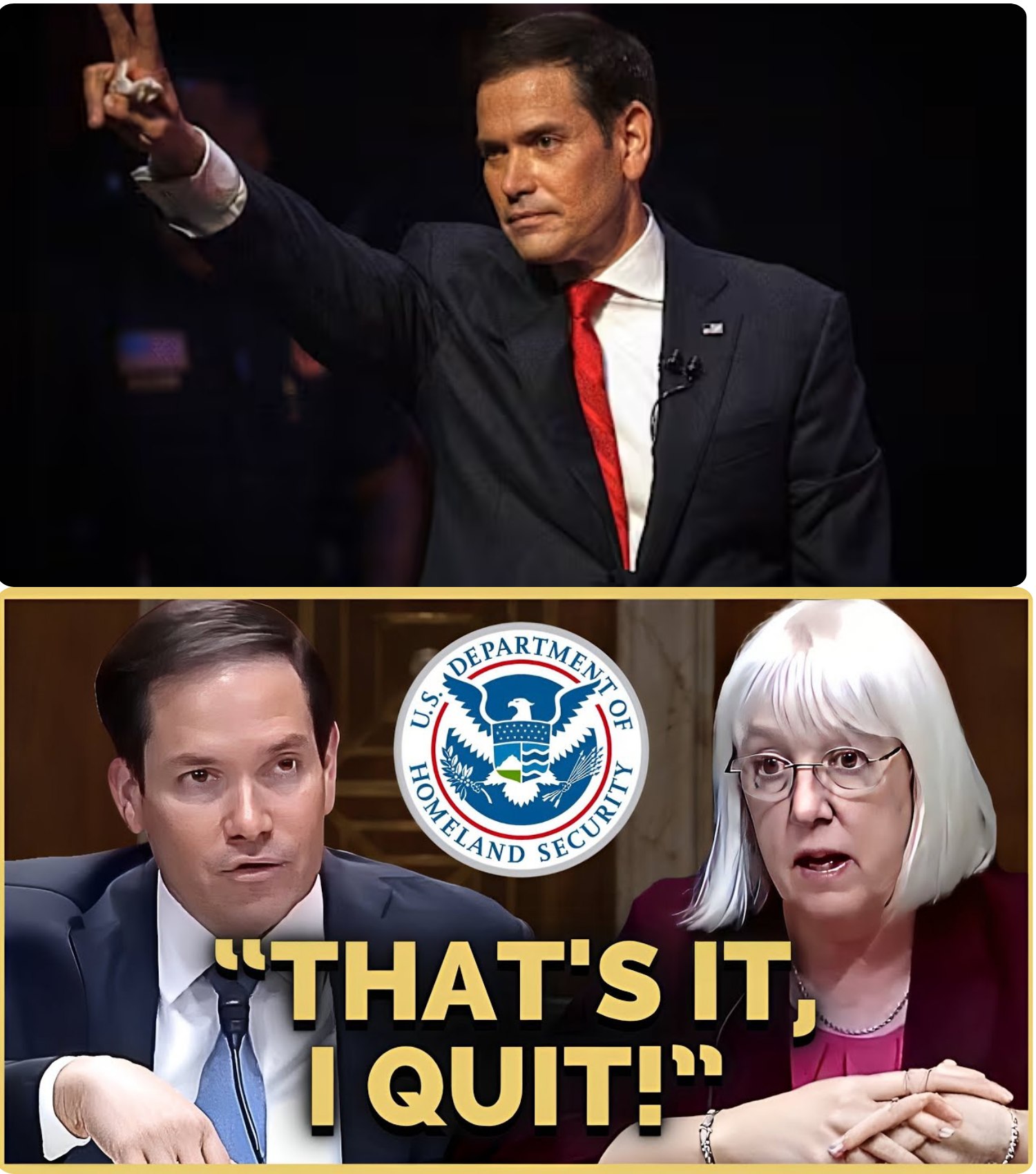
In today’s hyper-polarized political climate, congressional hearings have increasingly become stages for viral confrontations rather than forums for careful oversight. Cameras roll, clips spread across social media within minutes, and political figures on both sides of the aisle know that a sharp soundbite can sometimes matter more than a nuanced policy discussion.
One recent exchange involving Marco Rubio demonstrated exactly how quickly a political attack can backfire when the target remains calm, composed, and strategically disciplined. During a tense committee hearing, a Democratic lawmaker launched a sweeping accusation against Rubio, claiming that actions tied to foreign aid, congressional appropriations, and arrangements with El Salvador were “outright illegal.” What followed became one of the most talked-about political exchanges online.
The confrontation quickly evolved into more than just another Washington disagreement. Supporters of Rubio viewed the hearing as evidence of his growing stature inside conservative politics, while critics saw it as another example of deep divisions over foreign policy, immigration enforcement, and executive power.
This moment also revealed something larger about the current political era: voters increasingly judge leaders not only by policy outcomes, but by temperament under pressure.
A Congressional Clash That Captured National Attention
The hearing began with sharp criticism directed at Rubio regarding the restructuring of U.S. foreign assistance programs and the broader handling of international funding. The Democratic representative accused the administration of violating bipartisan appropriations laws, bypassing congressional authority, and undermining institutions built over decades.
Her remarks were forceful and emotionally charged. She argued that cuts to aid programs had created global instability, damaged American credibility overseas, and weakened humanitarian efforts. She also claimed that Congress had repeatedly requested transparency from the State Department but had not received adequate information.
The accusations escalated further when she described the administration’s conduct as a violation of constitutional spending authority. In modern American politics, accusations of illegality are no small matter. Such language immediately raises the stakes of any hearing and guarantees public attention.
But rather than responding emotionally, Rubio adopted a very different strategy.
Instead of interrupting or matching the aggressive tone, he calmly dismissed most of the allegations as inaccurate. At one point, he stated plainly:
“I disagree like 99% of it. It’s just not true. We’ve done nothing that’s illegal.”
That response instantly became the defining line of the exchange.
Rubio’s Political Style on Full Display
One reason the exchange resonated with so many viewers is because it highlighted Rubio’s political style — measured, disciplined, and rarely rattled under pressure.
For years, Rubio has cultivated an image as a policy-focused conservative capable of debating complex international issues while remaining composed in hostile settings. Unlike some political figures who thrive on confrontation through volume and outrage, Rubio often relies on calm rebuttals and concise counterarguments.
During the hearing, he repeatedly emphasized that Congress had already received hundreds of briefings and responses. He rejected the idea that the administration had hidden information and argued that many criticisms were exaggerated or politically motivated.
The contrast in tone became especially noticeable.
While the questioning lawmaker appeared increasingly frustrated, Rubio maintained a steady demeanor. To supporters, that composure projected confidence and competence. In political communication, appearance matters almost as much as substance, and many viewers interpreted his calmness as evidence that he was in control of the discussion.
This is one reason the clip spread so rapidly online. Political audiences today often respond more strongly to perceived emotional dominance than to technical policy details.
The Debate Over Foreign Aid and USAID
At the center of the hearing was a broader debate over U.S. foreign aid policy, particularly regarding United States Agency for International Development.
Critics of recent aid reductions argue that foreign assistance is one of America’s most important strategic tools. They believe humanitarian programs help stabilize fragile regions, strengthen alliances, combat disease, reduce poverty, and counter the influence of geopolitical rivals such as China and Russia.
Supporters of reducing aid spending, however, argue that many programs have become bloated, inefficient, or ideologically driven. They believe American taxpayers should not fund initiatives overseas that appear disconnected from core national interests.
Rubio’s defense reflected this second perspective.
He framed the administration’s actions as part of a broader effort to eliminate wasteful spending and redirect American resources toward national security priorities. Rather than presenting the cuts as abandonment of humanitarian responsibilities, he portrayed them as strategic reforms designed to strengthen the country.
This debate is hardly new. For decades, American politicians have argued over how much the United States should spend abroad versus at home. But in recent years, rising inflation, border security concerns, and growing skepticism about international institutions have intensified those arguments.
The hearing became a microcosm of that larger national debate.
El Salvador and the Immigration Question
Another major focus of the exchange involved cooperation with El Salvador on gang enforcement and deportation-related issues.
The Democratic lawmaker repeatedly demanded details about agreements involving individuals transferred to Salvadoran custody. Rubio responded that the United States had provided law enforcement assistance to foreign governments and that those governments had discretion regarding how the funds were used.
He also firmly rejected claims that U.S. residents had been deported improperly.
Immigration remains one of the most emotionally charged political issues in America. Discussions surrounding gang violence, border enforcement, deportation policy, and transnational crime frequently produce fierce disagreements between Republicans and Democrats.
Conservatives often argue that stronger enforcement measures are necessary to protect public safety and national sovereignty. Progressives frequently emphasize due process protections, humanitarian concerns, and oversight of executive power.
The Rubio hearing reflected both perspectives colliding in real time.
For many conservatives watching the exchange, Rubio’s comments reinforced the belief that the administration was prioritizing public safety and international cooperation against violent criminal organizations.
For critics, however, the lack of detailed transparency remained troubling.
Why the Exchange Went Viral
Several factors helped the confrontation explode across political media platforms.
1. The Emotional Contrast
Viewers are naturally drawn to moments of visible tension. The dramatic contrast between an aggressive line of questioning and Rubio’s composed responses created a highly shareable clip.
2. Clear Political Narratives
Both sides immediately framed the exchange to fit their broader political narratives.
Supporters portrayed Rubio as a calm, intelligent statesman unfairly attacked by partisan critics. Opponents argued that the hearing revealed ongoing concerns about accountability and executive overreach.
3. The Rise of Viral Politics
Modern political communication increasingly revolves around short-form video content. A hearing that once would have been watched only by policy insiders can now become national entertainment within hours.
Clips are edited, captioned, reposted, and amplified by influencers, commentators, and activists across the ideological spectrum.
In many ways, congressional hearings have become political theater designed not only for lawmakers in the room, but for millions of online viewers.
Marco Rubio’s Evolution in American Politics
The hearing also reignited discussions about Rubio’s future within the Republican Party.
Rubio’s political journey has been remarkable. He rose from local politics in Florida to become Speaker of the Florida House, then a U.S. Senator, and eventually a major national figure.
During the 2016 Republican presidential primaries, Rubio was often described as part of the party’s next generation — younger, articulate, and deeply knowledgeable on foreign affairs. Although he did not win the nomination, he remained influential within Republican politics.
Over time, Rubio’s political positioning evolved. He became more aligned with populist conservative priorities while continuing to emphasize international security and anti-authoritarian foreign policy.
That combination has made him increasingly appealing to many Republican voters who want both strong nationalism and experienced foreign policy leadership.
The recent hearing only strengthened that perception among supporters.
The Broader Debate About Government Spending
One recurring theme throughout the hearing was government spending and federal accountability.
Rubio’s defenders argue that reducing unnecessary spending is essential given America’s rising debt and economic pressures. They believe many federal programs expanded far beyond their original purposes and now require aggressive reform.
Critics respond that cuts to diplomacy and humanitarian aid can create long-term instability that ultimately harms American interests.
This tension reflects a philosophical divide over the role of government itself.
Should America continue funding expansive global programs designed to shape international outcomes?
Or should the federal government focus more narrowly on domestic priorities and direct national security concerns?
The Rubio exchange touched this nerve directly, which is another reason it resonated with so many viewers.
Leadership Under Pressure
Perhaps the most important takeaway from the hearing was not any specific policy disagreement, but the public perception of leadership under pressure.
In politics, difficult moments often define reputations more than prepared speeches.
Supporters praised Rubio for refusing to become emotional or defensive despite intense criticism. They saw his calmness as evidence of maturity and readiness for higher office.
Even some viewers who may not fully agree with his policies acknowledged that he appeared disciplined and confident throughout the exchange.
That matters politically.
Modern voters increasingly value emotional control, especially during conflict-heavy media moments. Leaders who appear composed are often perceived as more trustworthy and capable, regardless of whether audiences fully understand the policy details being discussed.
The Future of Political Hearings
This exchange also demonstrates how congressional hearings are changing in the digital age.
Hearings were once primarily mechanisms for gathering information and conducting oversight. Today, they also function as public performances shaped by cameras, clips, and online reactions.
Lawmakers know that a dramatic confrontation can dominate headlines and generate fundraising momentum. Political personalities know that viral moments help build national recognition.
As a result, hearings increasingly resemble televised debates rather than traditional policy discussions.
This transformation has advantages and disadvantages.
On one hand, it increases public engagement with government proceedings.
On the other hand, it can encourage performative conflict instead of detailed legislative problem-solving.
The Rubio exchange perfectly illustrated this modern reality.
Rubio’s Growing Influence
Whether one agrees with his policies or not, Rubio’s influence within Republican politics continues to grow.
His supporters view him as a rare combination of intellectual seriousness, communication skill, and political adaptability. He is experienced in foreign policy, immigration issues, national security debates, and legislative strategy.
Critics argue that his positions have shifted over time and that some policies associated with recent administrations remain deeply controversial.
But politically speaking, Rubio has demonstrated longevity in an era where many public figures rise and fall quickly.
Moments like this hearing reinforce his national profile because they showcase qualities many voters associate with executive leadership: composure, rhetorical discipline, and confidence under attack.
The Divide in American Politics
Ultimately, the hearing revealed how deeply divided the American political landscape has become.
To one side, Rubio represented strength, accountability, and pragmatic governance.
To the other, he represented executive overreach and insufficient transparency.
The same exchange produced entirely different interpretations depending on the viewer’s political perspective.
That reality defines modern American politics more than almost anything else.
Facts, tone, and performance are now filtered through intensely partisan lenses. Supporters and critics often watch the exact same event yet leave with opposite conclusions.
Conclusion
The fiery congressional confrontation involving Marco Rubio became far more than an ordinary political disagreement. It evolved into a viral symbol of today’s media-driven political culture — where moments of tension are instantly amplified, dissected, and weaponized online.
For Rubio’s supporters, the hearing demonstrated why he remains one of the Republican Party’s most effective communicators and potentially one of its strongest future national leaders. His calm responses under pressure, combined with his command of policy details, reinforced the image of a seasoned political figure capable of handling intense scrutiny.
For critics, however, the hearing highlighted ongoing concerns about transparency, foreign aid reductions, and executive authority.
Regardless of political perspective, one thing is clear: the exchange succeeded in capturing national attention because it reflected the broader battles shaping modern America — debates over immigration, foreign policy, spending priorities, constitutional authority, and the future direction of U.S. leadership.
And in the age of viral politics, moments like these do not disappear after the hearing ends. They become part of a much larger narrative about power, personality, and the fight for America’s political future.